

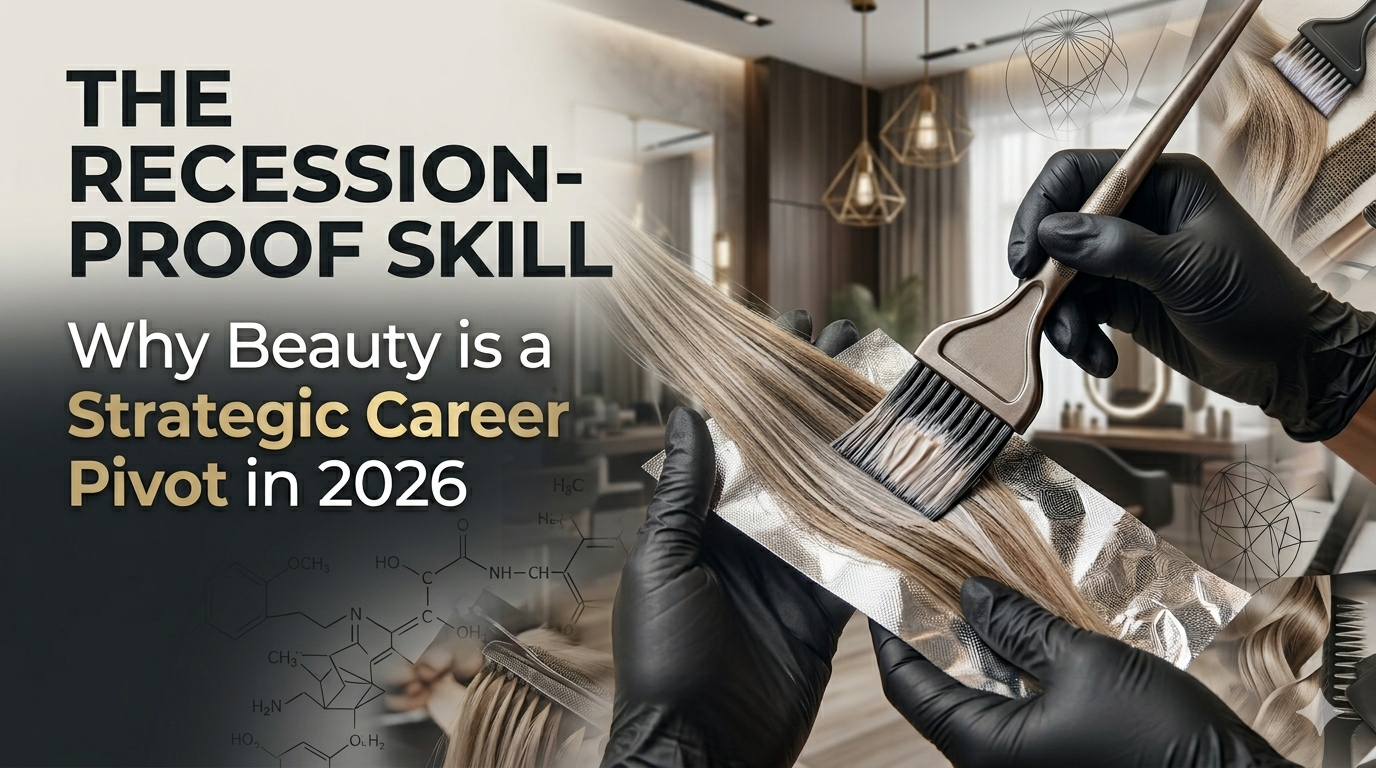
The Recession-Proof Skill: Why Beauty is a Strategic Career Pivot in 2026
The New Economic Reality The landscape of 2026 looks vastly different than the start of the decade. Automation has moved from the factory floor to the corner office, leaving many professionals questioning their long-term relevance. In this climate, the most strategic move isn’t digitizing—it’s humanizing.
The beauty industry stands as a fortress against the volatility of the modern market. While software can write code or manage schedules, it cannot replicate the nuanced touch of a master stylist. We are seeing a massive influx of talent choosing the chair over the cubicle for one reason: security.
This isn’t about “doing hair.” This is about entering a high-demand service sector that refuses to be outsourced. When you master a trade that requires physical presence and emotional intelligence, you become indispensable.
The Resilience of the “Affordable Luxury” History shows us that during economic contractions, consumers don’t stop spending—they shift their spending. Large-scale luxuries like international travel or new vehicles are the first to be cut from the budget. However, the maintenance of self-image remains a non-negotiable priority.
The “Lipstick Effect” has evolved into the “Self-Care Standard.” In 2026, looking professional and feeling confident is considered a tool for survival, not a vanity project. This ensures a consistent flow of clientele regardless of the broader economic forecast.
For the career-changer, this provides a rare level of income predictability. You are moving into an industry where your “inventory” is your skill and your time. These are assets that cannot be devalued by a stock market dip.
High-Touch in a High-Tech World We are living through a loneliness epidemic that technology has only accelerated. The salon has reclaimed its title as the “Third Place”—the essential social hub outside of home and work. This makes the modern stylist part technician, part therapist, and part community leader.
Clients are no longer just paying for a service; they are paying for the 60 minutes of undivided human attention. That connection is your competitive advantage over any automated service. As the world gets colder and more digital, the value of that warmth increases exponentially.
Choosing beauty in 2026 is a statement that you value human connection as much as financial gain. It is a sophisticated pivot for those who want to own their time and their craft. You aren’t just changing jobs; you are future-proofing your life.
The Income Math of 2026 The traditional “starving artist” trope of the beauty world is dead. With the rise of independent suites and sophisticated commission models, the earning potential for a disciplined stylist is higher than many mid-level management roles.
By treating your chair like a business from day one, you control your margins. You have the ability to scale your income through add-on services, retail curation, and specialized techniques. Unlike a corporate salary, your income isn’t capped by a boss’s budget.
The math is simple: high demand plus limited skilled supply equals premium pricing. As more people seek out these high-touch services, the stylists who position themselves as experts will see significant financial rewards.
H2: The Mentor Moment: Building Your Economic Moat To truly succeed in this pivot, you must build what I call an “Economic Moat” around your career. This means being so skilled and so connected to your community that you are impossible to replace. It starts with a commitment to technical mastery that goes beyond the basics.
Do not just learn to cut hair; learn the chemistry of color and the geometry of face shapes. Understand the psychology of your clients so you can anticipate their needs before they speak. A mentor knows that the most valuable part of the service happens during the consultation, not the execution.
You must also master the “Business of You.” Track your retention rates, manage your social proof, and understand your cost-per-minute. A stylist who knows their numbers is a business owner; a stylist who doesn’t is just a hobbyist.
Finally, never stop being a student. The moment you think you’ve “arrived” is the moment your career begins to stagnate. Seek out mentors who challenge you and stay hungry for the next level of excellence.
Pro-Tip Sidebar: The Pivot Playbook
- Audit Your Soft Skills: Your previous experience in management or customer service is your “secret sauce” in the salon.
- Focus on Retention: It is 5x cheaper to keep a client than to find a new one; make your follow-up game relentless.
- Specialize Early: Generalists are a commodity; specialists (like extensions or curl experts) dictate their own prices.